Masoud Mohammadirad

Projects

Echoes of Vanishing Voices in the Mountains: A Linguistic History of Minorities in the Near East:

This project, which is funded by the ERC and will run during the academic years 2021-2025, aims to reconstruct the complex, socioreligious past of the disappearing indigenous communities who were once more widespread across West Asia from the first millennium BC well into the Islamic period.

Mesopotamia is the home of remarkably diverse ethnoreligious and linguistic microcommunities with deep historical roots in the ancient Near East. Jewish and Christian minorites with their own unique traditions in Aramaic have co-existed alongside mainly Iranian speech communities for millennia. Today the origin and development of this rich cultural-linguistic mosaic remains elusive due to superimposed nationalisms and paucity of historical records.

Under the direction of Professor Geoffrey Khan an interdisciplinary team of both Aramaic and Iranian linguists will study the intertwined histories of the Aramaic and primarily Kurdish speaking communities through their linguistic traditions. A great deal of the linguistic evidence comes from the recently richly enhanced database of spoken Aramaic languages, which stretch back 3,000 years. One of the main outcomes will be a linguistic atlas of modern Aramaic dialects and an overview of convergences with Kurdish and Gorani dialects. For such an enterprise, further documentation of the endangered Aramaic and Gorani dialects is required.

Documentation of Hewramî

The Hewramî language and its varieties are under-documented, endangered languages spoken in a cluster within the Zagros mountains in Iran and Iraq. Hewramî is a member of the larger Gorani branch of Iranian languages. Over the last two decades, there has been a growing interest in documenting peripheral Gorani dialects leading to the publication of a few sketch grammars of these endangered dialects. Despite these welcome documentation efforts, the more conservative Hewramî varieties of Gorani have lacked a decent monograph-length description since MacKenzie’s (1966) scholarly work on the Luhon dialect of Hewramî.

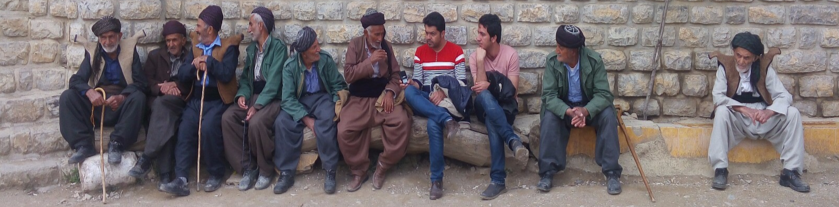
This project is based on a series of fieldwork missions in Hewraman Tekht (2016-2023), resulting so far in two monographs Echoes of the past: Hewramî narratives, and A grammar of Hewramî.

The Word Order Corpus in Western Asia

A spoken-language-based corpus for investigating areal effects in word order variation, maintained by the University of Bamberg. The principle aim of this research network is to provide an accessible and transparent source of data for corpus-based approaches to word order typology, focussing on the languages spoken in Western Asia.

Peace-Building Through the Documentation of Endangered Oral Culture in Iraq

The main objective is to produce parallel corpora of Neo-Aramaic and Kurdish folktales and to investigate the grammatical and lexical convergence of the Neo-Aramaic component of the corpus with the neighbouring Kurdish dialects. The underlying aim is to foster an understanding of shared cultural heritage between Christian and Muslim communities.

I was in charge of processing (transcription and translation) of the Kurdish tales in the project, and explored the stylistic features of oral narrative in Kurdish and Neo-Aramaic together with Paul Noorlander. The project resulted in the publication of Neo-Aramaic and Kurdish Folklore from Northern Iraq, 2 vols.

Atlas of Languages of Iran, Kordestan Province

Kordestan is one of four provinces in Iran where Kurdish is the main spoken language.

This project was carried out within the framework of the Atlas of the Languages of Iran. I carried out research on language distribution in the province and local place names for all localities.